

Reishi for Sleep and the Wind-Down That Does the Work

Reishi does not knock you out. It has been used in Chinese medicine for roughly two thousand years, classically to calm the spirit rather than as a bedtime dose, and the modern research is both more interesting and more limited than most labels admit. Here is what has actually been measured about reishi for sleep, and where it fits in a wind-down that still works on the nights you skip it.
What reishi is, and why it became an evening herb
Ganoderma lucidum is not a mushroom you cook. It grows as a hard, varnished bracket on hardwood stumps, woody enough to be inedible and bitter enough that nobody has ever put it in a risotto. Traditional preparation was a long simmer, and that detail matters more than it sounds.
The compounds people care about do not all come out in the same solvent. The polysaccharides, including the beta-glucans, are water soluble. The triterpenes, the ganoderic acids, are largely alcohol soluble and are what make reishi taste the way it does. Bitterness is a rough proxy for triterpene content, which is why bitterness is at least a rough signal worth noticing, though it is no substitute for a standardized figure on the panel. In a gummy it arrives as a concentrated extract, because nothing else gets it into a format you would willingly chew.
The oldest Chinese materia medica, the Shen Nong Ben Cao Jing, compiled around 200 CE from older oral tradition, lists lingzhi among the superior herbs. That category was reserved for substances thought gentle enough to take across a lifetime rather than briefly for an acute complaint. The name translates roughly as herb of spiritual potency. That record tells you how long people have been using it, and what they reached for it to do. It is a reason to investigate something, not proof of anything.
What the research on reishi for sleep has actually looked at
Most of what exists is preclinical, and most of it runs one test: how long a rodent stays under after a dose of pentobarbital. That is a screen for sedative-type activity, not a measure of sleep quality. A 2007 study found a G. lucidum extract shortened sleep latency in pentobarbital-treated rats. The informative part came next: flumazenil, a compound used experimentally to probe one site on the GABA-A receptor, reversed that effect in the animals, which points at GABAergic signaling as one plausible route. A shared pathway in a rodent screen is not the same thing as acting like a sedative medication, in animals or in people.
A 2021 paper in Scientific Reports went further. Mice received an acidic fraction of an alcohol extract of reishi mycelium at 25, 50 or 100 mg/kg for 28 days. At the top dose the treated mice stayed under the anesthetic roughly twice as long as controls, and a brain serotonin measure rose at the two higher doses. Both are screening readouts in animals: neither is a sleep measurement, and neither describes what a gummy does in a person. Then the researchers wiped out the animals' gut bacteria with antibiotics and both effects vanished, with Bifidobacterium enrichment tracking the changes. Part of whatever reishi does in that model appears to run through the gut rather than straight to the brain.
Human evidence is thinner, though it is moving. A late-breaking abstract presented at a 2026 sleep conference described an eight-week trial in 218 adults with diagnosed sleep difficulty, comparing a reishi extract at 980 mg nightly, standardised to 6 percent triterpenes, against 5 mg of melatonin. The reishi arm moved further on the questionnaire used, by about three points. Two things keep that in proportion: a conference abstract has not been through peer review, and 980 mg of a standardised extract is a different proposition from the reishi in any gummy, including ours. It is a reason to watch the field rather than a reason to expect the same of a sweet.
The most cited published trial is older and smaller: eight weeks, randomized and double-blind, 132 people recruited through a clinic for a diagnosed fatigue condition, taking a reishi polysaccharide extract at 1,800 mg three times daily. Self-reported fatigue fell 28.3% from baseline against 20.1% on placebo. A real separation, and a small one, from a single trial at a daily dose far above what any gummy delivers. Note what it measured: fatigue and wellbeing, never sleep itself.
Reading the evidence honestly
| What was studied | What it measured | What it reasonably supports | What it cannot tell you |
|---|---|---|---|
| Rodent pentobarbital tests | Time under anesthesia | A plausible GABA-linked mechanism | Human sleep quality or architecture |
| Mouse microbiome study, 2021 | Gut bacteria, hypothalamic serotonin | Part of the route may run through the gut | How mg/kg in mice maps to a serving |
| Human trial, 8 weeks, in a diagnosed clinical population | Self-reported fatigue and wellbeing | A modest change against placebo, in those patients, at 5,400 mg a day | Anything about sleep, which it never measured, or about healthy adults taking a gummy |
Where melatonin actually fits
Melatonin is a timing signal, not a sedative. Your body releases it as light falls, and its job is to tell the rest of you which part of the 24-hour cycle you are in. That is a different function from making you drowsy, and confusing the two is why people are so often disappointed.
The numbers are modest and well established. A meta-analysis of 19 trials covering 1,683 people found those given melatonin fell asleep about seven minutes earlier than placebo. Statistically solid, clinically small. Your own nightly output sits around 10 to 80 micrograms, while a common gummy delivers 5 or 10 milligrams.
Label accuracy is the sharper problem. A 2023 JAMA analysis of 25 melatonin gummy products found 22 outside their stated content, from 74% to 347% of the label claim, with one containing no detectable melatonin at all. An earlier survey found lot-to-lot variation inside a single product of up to 465%. Use above 5 mg a day among US adults more than tripled between 2005 and 2018, from 0.08 percent to 0.28 percent, so it is still uncommon, and long-term studies of nightly use at those doses have not been done. That is an open question in the literature, not a known harm.
None of that makes melatonin a villain. It makes unexamined nightly high-dose use a poorly mapped habit, and explains why some people want the botanical side of their evening carrying more weight.
Chamomile, lavender, and the case for a cue
Apigenin, the flavonoid in chamomile that gets the most attention, binds the benzodiazepine site of the GABA-A receptor in vitro, as a weak ligand — and in chamomile it arrives mostly as poorly absorbed glycosides, so the binding data is a hypothesis about chamomile rather than an explanation of it. Linalool, one of the two dominant volatiles in lavender alongside linalyl acetate, potentiates GABA-A receptors allosterically in cell studies, but neither lavender oil nor linalool shows affinity for the benzodiazepine site, and the best-characterised mechanism for standardised lavender extract is inhibition of voltage-gated calcium channels plus 5-HT1A modulation rather than anything GABAergic. Pairing the two is a formulation convention, not a mechanistic one.
The human data deserves the same honesty as reishi's. The best-known chamomile sleep trial randomized 34 adults to 270 mg of standardized extract twice daily or placebo for 28 days, and found no statistically significant differences in sleep diary measures. Sleep latency, night-time awakenings and fatigue severity leaned chamomile's way with moderate effect sizes, while total sleep time showed a moderate effect size in favour of placebo, and none of it reached significance — a 34-person pilot in a diagnosed clinical population cannot settle a question.
L-theanine has the cleanest evidence for the narrowest claim. In a triple-blind crossover study, a single 200 mg dose raised frontal alpha power and lowered salivary cortisol against placebo. That was the amount used in the study, which is not necessarily the amount in any given product — the supplement facts panel is the only place that tells you. Alpha power is the signature of relaxed wakefulness rather than drowsiness, which is the point.
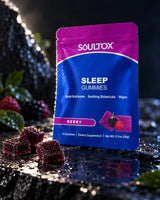
The strongest honest case for a botanical evening gummy is not that one compound switches you off. It is that a fixed, pleasant, ten-second action performed at the same point every night can become a cue, and cue learning is one of the better-established findings in behavioral research. SOULTOX SLEEP pairs reishi with chamomile, lavender and L-theanine. Four gummies a pack, $4.49, vegan and non-GMO. Read the supplement facts panel on any sleep product for what else is in there and how much, melatonin included.
The wind-down that does the heavy lifting
Worth saying plainly: general sleep hygiene advice, studied on its own, performs worse than its reputation. Several individual habits hold up better than the bundle does. None of what follows is medical advice, and none of it replaces a conversation with a clinician.
- One wake time, seven days a week. Waking inside the same 30-minute window, weekends included, does more for your sleep timing than anything you do after dark, and it is the least popular advice in the field.
- Get outside early. An overcast morning still delivers thousands of lux. A brightly lit room delivers a few hundred. Outdoors beats indoors by roughly an order of magnitude in illuminance, so a short walk is worth more than it looks, and morning light anchors the evening end of the cycle.
- Respect caffeine's tail. In one controlled crossover study of 12 adults, 400 mg taken six hours before bed cut objectively measured total sleep time by 1.1 to 1.2 hours, while their own diaries registered only 41 fewer minutes, a gap that did not reach significance — they did not notice. Half-life runs near five hours, with wide variation.
- Let the room get cold. Core temperature has to fall roughly one to two degrees Fahrenheit before sleep begins, and a warm room slows that. Common guidance lands near 65 to 68°F, with large self-tracked datasets showing poorer sleep outside a similar band.
- Alcohol is the false friend. It shortens the time it takes to fall asleep and degrades the second half of the night. The most self-prescribed wind-down, and the one most likely to backfire.
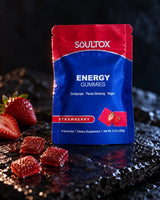
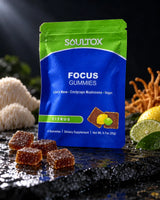
The caffeine point is where our own lineup has to be honest with itself. SOULTOX ENERGY carries 25 mg per gummy — 100 mg if you finish the four-gummy pack, which is about a cup of coffee, and the timing rule still applies: keep it in the first half of the day. For a late afternoon that leaves your evening alone, SOULTOX FOCUS gummies lean on Lion's Mane and Cordyceps instead. Clear head, no coffee.
How to read a reishi label
A 2018 DNA study sequenced 20 manufactured reishi products and found a species other than the one on the label in all but two. None contained G. lucidum in the strict taxonomic sense, and 93% were Ganoderma lingzhi, the species most Asian cultivation and research has actually used. That is taxonomic drift more than fraud: the science revised the name after the market had standardized on it. It still means the species line is a category, not a guarantee.
Three other things. Whether you are getting fruiting body or mycelium grown on grain, since grain substrate carries starch that inflates a polysaccharide number. Whether an extract ratio like 10:1 names its solvent, since water-only extraction leaves most of the triterpene behind. And whether a beta-glucan figure appears at all, because it beats the vaguer word polysaccharides.
Who should avoid reishi
In the human studies available so far, reishi has generally been reported as well tolerated over short periods. Reported effects with extended use include stomach upset, dry mouth and dizziness. Laboratory work suggests reishi may affect how platelets behave, so if you take an anticoagulant or antiplatelet medication, or have surgery coming up, ask your healthcare provider before using it. Rare liver injury case reports exist, mostly with powdered products taken for long stretches. Safety data in pregnancy and breastfeeding is not adequate, so skip it there.
And the part supplement companies tend to mumble: persistent trouble sleeping is worth a conversation with a doctor, not a gummy. A supplement belongs to a routine. Anyone framing one as the answer to a problem is selling harder than the evidence allows.
Common questions
Does reishi make you sleepy?
No. Reishi is not a sedative and there is nothing to feel taking hold. The research points toward calm-signaling pathways rather than a knockout effect, and traditionally it was taken habitually rather than as a nightcap. Judge it across weeks as part of a routine, not 20 minutes after the first one.
Is reishi a melatonin-free option for an evening routine?
Reishi is not a melatonin source in any meaningful sense: trace melatonin has been detected across a range of fungi, Ganoderma included, at levels nowhere near the milligram doses in a melatonin product. It is a mushroom extract, working on entirely different pathways from a hormone that signals time of day. Plenty of finished sleep products do add melatonin alongside botanicals, so read the supplement facts panel on whatever you are holding, for both ingredient and amount.
Can you take reishi every night, and when?
Traditionally it was used continuously, in the category of herbs considered suitable for regular use. Modern long-term human data is thin, while short-term tolerability looks good. Most people attach it to the last half hour before bed, since the routine does part of the work. If you take prescription medication, particularly blood thinners, clear it with a clinician first.
Fruiting body or spore powder?
Most human research has used polysaccharide extracts from fruiting body or mycelium. Spore powder has been through small human pilot trials too — a 2012 randomized trial in 48 breast cancer patients reported less fatigue and better quality of life — but none of that work looked at sleep. Neither is clearly better for evening use. Extraction method and honest labeling tell you more than the part named on the front.
If your evenings need a shape more than they need a knockout, that is what SOULTOX SLEEP reishi gummies were built for. Cheaper per pack inside a build-your-own bundle, alongside whatever handles your mornings.
This article is general information, not medical advice, and nothing here is intended to diagnose, treat, cure or prevent any condition. Talk to your own healthcare provider before starting any supplement, particularly if you are pregnant or nursing, take prescription medication, or have an ongoing health condition. These statements have not been evaluated by the Food and Drug Administration. This product is not intended to diagnose, treat, cure or prevent any disease.