

Creatine Gummies vs Powder, Compared Honestly

Creatine monohydrate has more human trial data behind it than almost anything else in sport nutrition. Creatine gummies are new, cheap to launch, and in 2025 several independent testing rounds, including published results from NOW Foods and an ISO 17025 accredited lab commissioned by SuppCo, reported that a number of the gummy products tested fell short of their stated creatine content. Creatine gummies vs powder, then, on dose, cost and shelf stability. No winner picked in the first paragraph.
What creatine actually does inside a working muscle
Muscles run on ATP, and a hard set burns the stored supply in a handful of seconds. The fastest route to rebuilding it is phosphocreatine handing a phosphate group back to ADP, a reaction run by creatine kinase. That is what carries the last two reps of a heavy set and the back half of a sprint. More phosphocreatine means a deeper reserve for that. The benefit shrinks as efforts get longer and slower, though creatine also has documented roles in recovery between efforts, glycogen resynthesis and tolerating heavy training loads.
You already carry a lot of it. Total body creatine is around 120 to 140 grams in a 70 kg adult, about 95% of it in skeletal muscle, near 120 mmol per kg of dry muscle. The ceiling is around 150 to 160 mmol/kg in most people. Your liver and kidneys make roughly a gram a day, an omnivorous diet adds another gram or two from meat and fish, and you lose about 1.7% of the pool daily as creatinine.
Supplementing is not filling an empty tank. It is topping off one that is normally three-quarters full. That last quarter is where the performance research lives, and why the effect is real but moderate.
Why creatine is the most-studied supplement on the shelf
Hundreds of randomized trials across several decades. The International Society of Sports Nutrition's position stand calls creatine monohydrate, in its own words, "the most effective ergogenic nutritional supplement currently available" for increasing high-intensity exercise capacity and lean body mass during training, and reports that intakes of up to 30 g per day for as long as five years were well tolerated by the healthy adults in the trials it reviewed.
Read the effect sizes honestly and they are useful rather than dramatic. Meta-analyses of creatine plus resistance training report around 1.1 to 1.5 kg more lean tissue mass than training alone, with strength gains that are consistent in direction but small in size — pooled effect sizes across the strength literature generally land around 0.2 to 0.3, which on a bench press is a couple of kilos rather than a transformation, and some of that early mass is intracellular water rather than contractile tissue. Roughly 20 to 30% of people are classed as non-responders, defined as gaining under 10 mmol/kg dry weight after five days at 20 g per day, usually because their stores were already near the ceiling. Vegetarians, who start lowest, tend to respond most.
Creatine supports strength and power output during training. It does not replace the training.
The loading phase argument was settled in the nineties
Loading means 20 to 25 grams a day, split across four or five doses, for five to seven days. It works, and muscle stores saturate inside a week. The part that gets left out: work by Harris and colleagues in the early nineties, and by Hultman and colleagues in 1996, showed that about 3 grams a day for 28 days arrives at the same muscle creatine concentration. Same endpoint, reached about four times slower. Front-loading buys speed, not a higher ceiling.
That reframes the gummy question. Loading on a low-dose chewable is expensive and tedious. Maintenance is a few grams a day, indefinitely. What decides the result is whether you keep going.
Creatine gummies vs powder, head to head
| Axis | Powder | Gummies |
|---|---|---|
| Cost per 5 g | $0.10 to $0.40, plain micronized | Commonly $0.80 to $2.00 per 5 g equivalent |
| Dose per serving | One scoop, 5 g, no arithmetic | 0.5 to 1.5 g per gummy, so four to ten of them |
| Shelf stability | High while dry and sealed | The format's structural weak point |
| Loading phase | Straightforward | Impractical and costly |
| Travel | Powder, a scoop, security questions | Goes in a bag, forgotten |
| Verification | Mature, many certified products | Young, poor testing record so far |
Powder wins on cost by roughly five to eight times. It wins on dose density, on stability, and outright if you intend to load. No honest reading of that puts a gummy ahead on what a lifter tracks.
The stability problem, in actual numbers
Creatine cyclizes into creatinine, a waste product with no ergogenic value. The reaction follows first-order kinetics and accelerates with heat and with acidity. Dry crystalline creatine barely does it. Dry creatine monohydrate has been held for more than three years at room temperature and at 40 °C with no detectable degradation, creatinine staying under 67 ppm. It only starts cyclizing once it picks up enough moisture to dissolve in its own surface water.
Put creatine into water and the numbers get specific. Over 39 days in solution, monohydrate converted to creatinine like this:
| Condition | Converted to creatinine |
|---|---|
| pH 7.0, 40 °C, 39 days | About 28% |
| pH 3.0, 40 °C, 39 days | About 74% |
| pH 3.0, 4 °C, 39 days | About 62% |
Look at the last row. Refrigeration did not rescue an acidic solution, because pH matters more here than temperature. That counts, because a gummy is cooked in water and fruit-flavored gummies are almost always acidified with citric acid. It is the exact combination the kinetics punish while the mix is hot and fully hydrated during manufacture. A set gummy is not a solution — its water activity is much lower, so the reaction slows once it cures — but the rates above are measured in free solution and should not be read directly as a finished gummy's shelf life.
The testing rounds were the predictable consequence. NOW Foods tested 12 creatine gummy brands in early 2024 and six of them failed their label claim, a 46% failure rate. An ISO 17025 accredited lab commissioned by SuppCo tested six and found four with essentially no creatine. A separate round on nine brands found five delivering under 0.1 grams per serving. In several failures the labs also measured creatinine, which points at creatine that was added and then degraded. It does not explain everything: NOW reported that for its failing products, creatine and creatinine added together still did not reach the label claim, so some of the gap was creatine that was never there.
That is a formulation and handling problem, not a law of physics. A gummy can be built at a pH that protects the active, and verified lot by lot. But the burden of proof sits with the gummy.
Where the gummy format genuinely earns its place
One variable outranks every other in supplement research: adherence. A format you take daily at 3 grams beats one you take twice a week at 5. If a tub has sat unopened since February because you cannot stand the texture, its cost per gram is worth nothing.
- No water, no shaker, no grit in the bottom of the glass.
- Travels without loose powder or a conversation at airport security.
- Lives on a desk or in a gym bag, where daily habits actually survive.
- Carbohydrate taken with creatine increases how much of it the muscle takes up, by an insulin-mediated route. Green and colleagues found about 60% greater muscle total creatine accumulation in 1996, but they used 93 g of simple carbohydrate four times a day, close to 370 g. A gummy's worth of sugar is nowhere near that, so it probably does little. A footnote, not a reason to choose sugar.
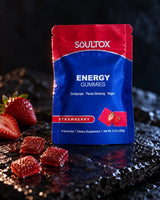
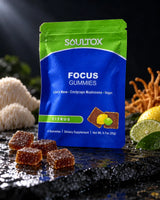
Dose density is the whole issue. Half a gram of a mushroom extract fits into one gummy easily, which is why the Lion's Mane and Cordyceps in our focus gummies and the 25 mg of caffeine per gummy in our energy gummies sit comfortably there. Five grams of creatine is ten times that. A brand that puts a full daily creatine dose in one small gummy is claiming something the chemistry makes very hard.
How to read a creatine gummy label
- Find the milligrams, then the serving size. A panel might say 3,000 mg of creatine monohydrate per serving, and the serving might be four gummies. Divide. That is the real per-gummy dose.
- Do the daily arithmetic before you pay. Target grams divided by grams per gummy. If the answer is eight, decide whether you will eat eight gummies a day for a year.
- Refuse proprietary blends. "Creatine blend" with no milligram figure per ingredient is not a disclosure, it is a way of avoiding one.
- Ask for a finished-product certificate of analysis, by lot. Raw material specs only tell you what went into the kettle. You want what came out, with creatinine reported next to creatine. That number is the honest tell.
- Value certification of the finished product, such as NSF Certified for Sport or Informed Sport, over a logo about the raw ingredient.
- Store it cool, dry and sealed. A pack that spent a week in a hot car is not the product you paid for.
- Ignore "absorbs better" claims. Monohydrate absorption is already close to complete, and the rate-limiting step is the SLC6A8 transporter moving creatine into the muscle cell, not your gut.
So what should you actually buy
If you are loading, counting cost per gram, or training seriously enough to log your lifts, buy a tub of plain micronized creatine monohydrate. It is the cheapest, most stable and best-documented way to get creatine into a human, and we will not pretend otherwise to sell a gummy.
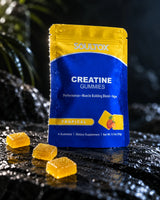
If the reason you are reading this is that powder keeps not happening, the calculation changes. Our creatine gummies come four to a pack at $4.49, vegan, gluten-free and non-GMO, with creatine monohydrate as the active at 1000 mg per gummy — which is 5 gummies and $5.61 for a 5 g dose, against $0.10 to $0.40 for the same dose of powder. Read the Supplement Facts panel, run steps one and two on it, and decide with the number in front of you. That applies to ours as much as anyone else's.
Plenty of people run both: powder at home, a pack in the bag for travel weeks. If you are stocking more than one thing, the build-a-bundle page brings the price per unit down.
Common questions
Do creatine gummies work?
A gummy can deliver the same creatine as a scoop of powder, and support the same training outcomes seen in the research, when it contains what the label claims and you take enough of them per day. The format is not the obstacle. Dose per gummy and shelf stability are, and 2024 and 2025 lab testing showed many products failing on the second. A label check and a lot-specific certificate of analysis matter more here than in almost any category.
How many creatine gummies equal a scoop of powder?
Entirely product-dependent. Per-gummy doses typically run 0.5 to 1.5 grams, so matching a 5 gram scoop can take three to ten gummies. Divide the milligrams on the panel by the gummies in a serving.
Do I need a loading phase?
Not necessarily. In published trials, 20 to 25 grams a day for five to seven days saturated muscle stores faster, while about 3 grams a day for four weeks reached a similar concentration. Loading buys time, not a higher ceiling. Reports of digestive discomfort in the literature cluster around large single doses, which is why most published protocols divide the daily amount into smaller servings.
Does stomach acid destroy creatine before it is absorbed?
That argument is mostly marketing for pricier creatine forms. Gastric transit is short and monohydrate absorption is close to complete. The degradation worth worrying about happens inside the product before you eat it, not inside you.
Is creatine safe to take every day?
The ISSN position stand reports that, across the trials it reviewed, intakes of up to 30 g per day for as long as five years were well tolerated by healthy adults. That is a summary of published research in study populations, not an assurance about any individual. One practical note: creatine intake can raise measured serum creatinine on a blood panel. Mention that you supplement to the clinician who ordered the test so they can interpret the result. If you have any medical condition, are pregnant or nursing, or take prescription medication, talk to a healthcare provider before starting any supplement rather than relying on a blog post.
Creatine is the rare case where the research base is unusually deep, and what that research keeps pointing to is consistency of intake. If a pack in your bag is what makes that happen, the creatine gummies are here. If a tub on the counter does it, use the tub. Consistency does the work.
These statements have not been evaluated by the Food and Drug Administration. This product is not intended to diagnose, treat, cure or prevent any disease.