
Electrolytes and Why Water Alone Falls Short

Most hydration advice stops at "drink more water." That works right up until it doesn't, and the reason is chemistry rather than willpower. Do you need electrolytes, or is plain water enough? Here is what sodium, potassium and magnesium do, where water alone runs out, and how to read an electrolyte label without paying a premium for sugar.
Electrolytes, defined without the hand-waving
An electrolyte is a mineral that carries an electrical charge once it dissolves. The ones that matter most are sodium, potassium, chloride, magnesium and calcium. They are not fuel. They are the wiring.
Sodium sits mostly outside your cells, potassium mostly inside. That difference across the membrane is a stored voltage, and your body spends real energy holding it there. The sodium-potassium pump, Na+/K+-ATPase, moves three sodium ions out for every two potassium in, and estimates put its running cost at roughly 20 to 30 percent of resting ATP use. Every nerve signal and muscle contraction is that gradient briefly collapsing and being rebuilt.
Magnesium works differently. It is a cofactor for more than 300 enzymes by conservative counts and over 600 by broader ones, including the kinases and phosphatases that move phosphate groups around, and ATP is biologically active as its magnesium complex, Mg-ATP. Chloride follows sodium to balance charge, and calcium is the trigger inside muscle fibers. Water is only the medium all of this happens in. It does not replace what is dissolved in it.
What sweat actually takes out of you
Sweat varies between people, and sodium dominates it. Published ranges put sweat sodium anywhere from about 200 mg per liter to over 2,000 mg per liter, with averages landing a little under 1,000 mg/L. That is a tenfold spread between two people in the same gym. Genetics is a major driver, and a study of 157 marathoners found sweat sodium unrelated to age, body size, sweat rate or training history, with individual values spanning 7 to 95 mmol/L. It is not fixed, though: heat acclimation increases sodium reabsorption in the sweat duct and lowers sweat sodium over about ten days, and dietary sodium and exercise intensity move it as well.
The other minerals leave in far smaller amounts. Potassium runs around 80 to 390 mg per liter of sweat, magnesium under 10 mg. Sweat rate itself ranges from about 0.3 to 2.5 liters per hour depending on effort, heat and body size.
Two conclusions follow, pointing in different directions. Sodium is what you lose in bulk when you sweat hard. Potassium and magnesium are where ordinary diets fall short, sweat or not. Average potassium intake in the United States runs about 2,300 mg per day for women and 3,000 mg for men, against a labeling Daily Value of 4,700 mg that under 3 percent of adults reach. That 4,700 mg figure is a labeling benchmark rather than a requirement: the National Academies set the Adequate Intake at 2,600 mg for women and 3,400 mg for men in 2019, and plenty of adults still land below that lower target. Reported magnesium intakes also commonly fall below the amounts recommended for adults.
Do you need electrolytes, or just water?
Thirst is an osmotic sensor, not a fluid gauge. Osmoreceptors in and around the hypothalamus track plasma concentration. Vasopressin release comes first, with a threshold around 280 to 285 mOsm/kg, and thirst follows a few mOsm/kg later, with measured thresholds running from about 281 to 295 depending on the study. Drink a large volume of plain water after heavy sweat loss and the sodium concentration in your blood falls simply because there is more water around it. As concentration falls, thirst switches off and the kidneys clear the extra fluid, so you can stop feeling thirsty while you are still short on both water and sodium.
Endurance researchers make the same point from the other direction: plain volume is a poor target. Studies that have tracked marathon runners through a race keep landing on the same behavioral pattern in the people who run into trouble, which is drinking well past thirst. Gaining weight over the course of the race, taking in more than three liters, drinking at every mile marker. The takeaway is not that water is bad. It is that volume alone is a bad thing to aim at, and that how much fluid and sodium suits you over a long event is a question for your own healthcare professional rather than a rule of thumb.
Most of the time water is enough. A 45-minute air-conditioned gym session, a desk day, a walk in mild weather. Drink water, eat normally, move on. Electrolytes earn their place when one of these applies.
- Hard training past 60 to 90 minutes, especially in heat or humidity.
- A high sweat rate sustained over a couple of hours. Sports nutrition sources commonly start discussing added sodium once sweat losses run above roughly 1.2 liters per hour on long sessions, though individual needs vary widely.
- You are a visibly salty sweater. White residue on a cap, gritty skin, sweat that stings your eyes.
- Sauna, hot yoga, outdoor work, or long travel days in dry air.
- A diet light on potassium-rich food, which describes most diets built on convenience items.
The sugar question, and why a little actually helps
Sugar in a hydration drink has a legitimate job, and it is smaller than most labels imply. Sodium and glucose cross the intestinal wall together through a shared transporter, SGLT1. Crane proposed the cotransport mechanism in 1960, and the transporter protein itself was not cloned until 1987. Water follows them osmotically. That single mechanism is why a small amount of glucose alongside sodium moves water across the intestinal wall more readily than water on its own does.
For a reference point, the most absorption-focused formulas studied in the research literature sit very low on sugar: on the order of 13.5 grams of glucose per liter, about 1.35 percent, paired with sodium and potassium. Those are formulated for uptake rather than flavor, and they are clinical-research compositions rather than consumer drinks.
Sports drinks sit higher, usually near 6 percent carbohydrate, roughly isotonic and quick to leave the stomach. A crossover trial comparing 3 percent carbohydrate, 6 percent and plain water during cycling found no advantage in gastric emptying, intestinal water absorption or time-trial performance from dropping to 3 percent, while total solute absorption was higher at 6 percent. That is one small study rather than a settled literature, but it makes 6 percent defensible when you want fuel too. Push toward the 10 to 15 percent of juice and soda and gastric emptying slows measurably, which is why sports nutrition sources generally steer away from drinks above roughly 500 mOsm/kg during exercise.
So the rule is not "sugar bad." A small amount assists water absorption. Everything above that is ballast you pay for and carry.
How to read an electrolyte drink label
Nutrition panels are honest documents that are easy to misread. Five lines do most of the work.
| On the label | What it tells you | Where it gets slippery |
|---|---|---|
| Serving size | The basis for every other number | A 20 oz bottle listed as two servings halves every figure on it |
| Sodium in mg | The main sweat electrolyte, and the one that drives fluid retention | Few ready-to-drink products approach the 1,000 mg lost in a liter of sweat |
| Potassium and magnesium in mg plus %DV | Contribution against a 4,700 mg and 420 mg Daily Value | "With electrolytes" on the front can mean single-digit milligrams on the back |
| Total sugars vs added sugars | How much sweetness came from fruit and how much was poured in | Sugar from fruit juice concentrate counts as added sugar only for the amount above what the same volume of single-strength 100% juice of that type would contain, and the Daily Value for added sugars is 50 g |
| Proprietary "electrolyte blend" | That the amounts are not being disclosed | A blend total tells you nothing about the individual minerals in it |
One more check. Read the ingredient list before the panel. Ingredients run in order of weight, so if a sweetener sits second, the drink is soda with minerals in it.
How SOULTOX Fruit Fusion is built, and what it is not
Fruit Fusion was designed around a daily-drinking constraint, not a race-day one. Here is the whole panel for a 12 fl oz can.
| Per 12 fl oz can | Amount | %DV |
|---|---|---|
| Calories | 30 | Not applicable |
| Total sugars | 8 g, 6 g of it from fruit | Not applicable |
| Potassium | 90 mg | About 2% |
| Magnesium | 21 mg | 5% |
| Dietary fiber | 1 g | About 4% |
| L-theanine | 50 mg | No established DV |
| Vitamins B3, B6, B12 | 25% DV each | 25% |
Fruit ingredients and monk fruit do the sweetening instead of syrup, which is how the total lands at 8 grams, with only 2 of them declared as added sugar on the panel. Thirty calories keeps it a drink rather than a snack. The potassium and magnesium are a contribution toward the day, not a mega-dose, and saying that plainly beats dressing up 5 percent of a Daily Value. The B vitamins are cofactors in normal energy metabolism, not stimulants.
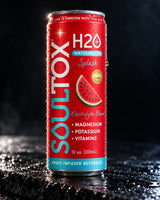
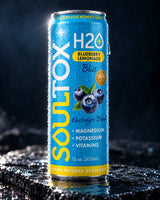
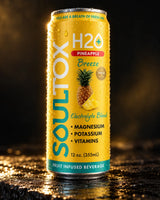
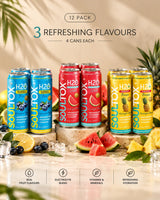
What it is not: a high-sodium endurance formula. If you are a salty sweater heading out for three hours in July, salt your food and use a dedicated sodium product for the session. Fruit Fusion is built for the rest of the week, the afternoon after training, the hot commute, the long flight. Watermelon Splash is the most straightforward of the three. Blueberry Lemonade Bliss runs tarter. Pineapple Breeze is the tropical one, and the one to serve very cold.
Building it into a normal week
Food does most of the work. Potatoes, beans, yogurt, leafy greens, nuts and seeds carry far more potassium and magnesium than any can. Salt your food to taste if you train in heat. Use a drink for the moments when food is not happening: after a session, mid-afternoon, in the car. The obstacle is friction rather than motivation, so keep a case cold, and building a bundle brings the per-can price down. If you are pregnant or nursing, taking any medication, or under a healthcare professional's care, talk with them before making any mineral-containing drink a regular habit.
The L-theanine part, described honestly
L-theanine is an amino acid found in tea leaves. Each can holds 50 mg, which is not arbitrary. It is the dose used in the EEG work that made the ingredient interesting.
In that work, published as a conference abstract, 16 healthy young volunteers given 50 mg showed a greater rise in alpha-band activity than the 19 on placebo, measured from 45 to 105 minutes after dosing. Alpha activity is associated with relaxed alertness rather than drowsiness. Participants were not performing attention tasks, though: they rested with their eyes closed in the first experiment, and a second experiment repeated the result during passive activity. Separate work has paired theanine with caffeine and reported effects on attention performance, but those trials used roughly 100 to 250 mg of theanine alongside 40 to 150 mg of caffeine, so their attention results say nothing about 50 mg of theanine on its own. All of that research looked at the isolated ingredient under lab conditions. None of it studied Fruit Fusion, and none of it was designed to predict what a can will do for any individual.
The limits deserve equal billing. Small samples, mostly single doses, mostly young healthy adults, mixed results across cognitive measures, and much of the literature uses 100 to 200 mg. None of that promises anything about your afternoon. The accurate version: research has investigated theanine in the context of calm alertness, the effects observed are modest, and 50 mg is the researched low end. That is why it is in the can, and that is as far as the claim goes.
Common questions
Do I need electrolytes for a one-hour gym session?
Usually no. For an hour indoors at moderate intensity, water and normal meals cover it. The math changes with heat, humidity, sessions past 60 to 90 minutes, a high sweat rate, or two sessions in a day.
Is 8 grams of sugar too much for a hydration drink?
It is at the low end for the category. The Daily Value for added sugars is 50 g, and only 2 of the 8 grams in a can are added, the other 6 arriving with the fruit. A little sugar assists sodium and water absorption through SGLT1, so a sugar-free drink is not automatically the better one.
Can I skip the drink and eat a banana instead?
For potassium, food wins. A medium banana carries around 422 mg, several times what a can provides, and potatoes and beans carry more. Drinks are for fluid and convenience, not for out-competing produce.
Why is there not much sodium in SOULTOX Fruit Fusion?
Because it was built as a daily drink, not an endurance formula. Replacing the sodium in a liter of salty sweat takes far more than any 12 oz can delivers. For long hot sessions, add sodium through food or a dedicated product.
Will L-theanine make me sleepy?
The EEG research points the other way. The alpha increase seen at 50 mg is a marker of relaxed wakefulness rather than of sleep onset, and volunteers were awake throughout, though they were resting or doing passive tasks rather than attention tests. Responses vary, the samples are small, and this is not a sedation claim in either direction.
If a low-sugar can in the fridge is the hydration you will actually reach for, Fruit Fusion is $3.29 a can, twelve to a case, in three flavors. Read the panel first. It is short, and it says exactly what it is. This article is general information about hydration, not medical advice. Nothing here is intended to diagnose, treat, cure or prevent any disease, and Fruit Fusion is a beverage rather than a treatment for any condition. For questions about your own hydration, medications or health, talk to a qualified healthcare professional.
These statements have not been evaluated by the Food and Drug Administration. This product is not intended to diagnose, treat, cure or prevent any disease.